A Family Jet Bound for the Bahamas Fell 27,000 Feet in a Single Minute — And the Cockpit’s Final Words Were Caught on Tape
It began with a calm report about “manageable” ice over Florida. Ninety seconds later, a 20-year-old co-pilot was radioing a countdown no one should ever have to hear.
3 November 2026 · 7 min read
At 12:47 on Sunday afternoon, the voice on the radio was calm. A Learjet 60 was cruising at 35,000 feet above Palm Beach County, Florida, and the young co-pilot was reporting the weather the way pilots do a hundred times a career. It was −47°C outside. There was “light, clear ice that is manageable and moderate turbulence,” she told Miami’s air traffic controllers.
Ninety seconds later, that same voice was screaming.
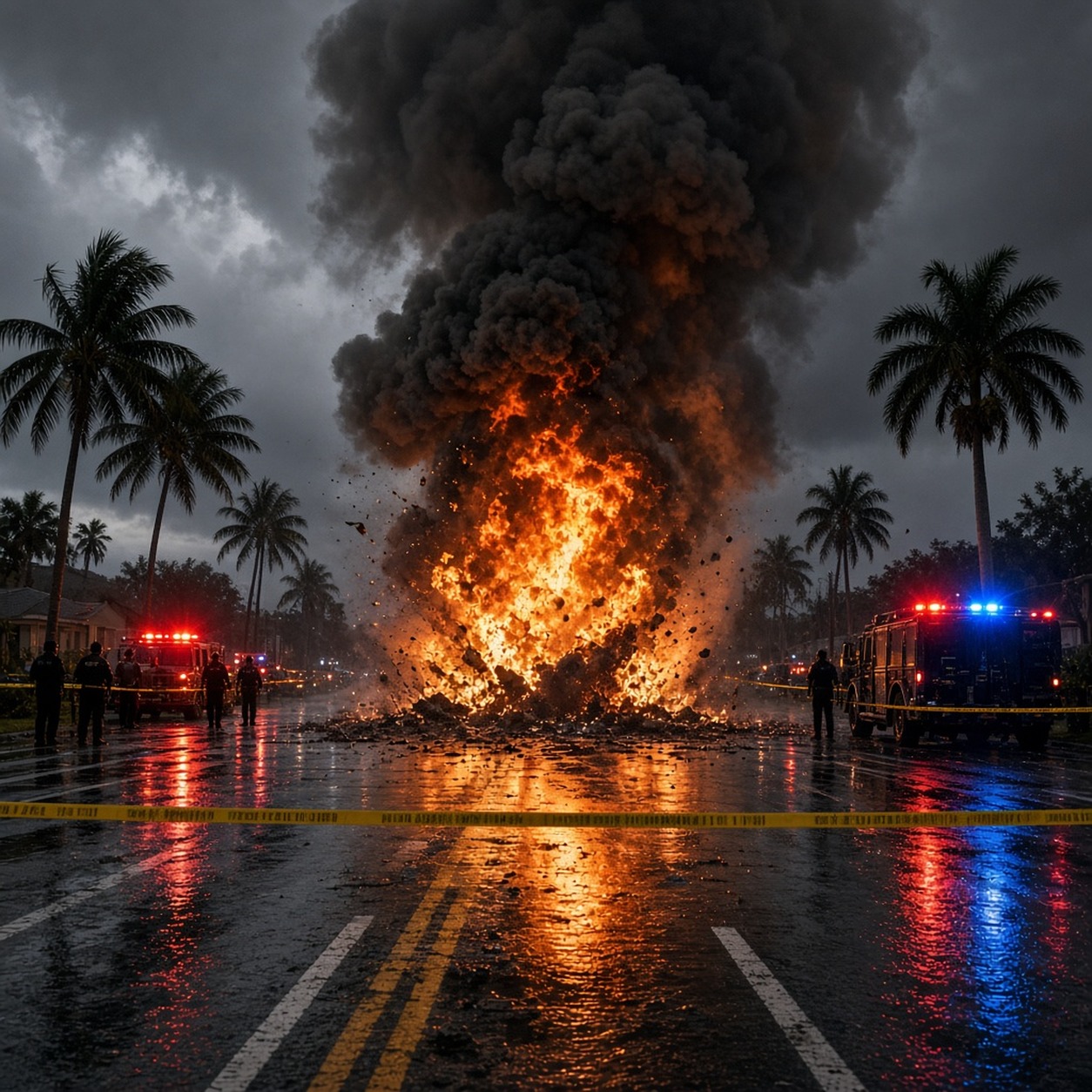
The jet — a charter flight from Austin, Texas, to North Eleuthera in the Bahamas, carrying two pilots and seven passengers — fell 27,000 feet in roughly one minute, according to flight-tracking data from ADS-B Exchange. It struck a busy road near Greenacres just before 1 p.m., erupted into a fireball and killed everyone on board. The radio recordings of those last moments, captured by LiveATC.net, are among the most harrowing ever made public. And the question investigators now face — what could take a healthy business jet from routine to catastrophe in under two minutes — may sit at the bottom of a flooded crater.
The Request That Changed Everything
The flight had left Austin-Bergstrom International Airport at 10:37 a.m. Eastern time. By the time it reached South Florida, scattered storms were moving through the area, and CNN reports the plane passed through a strong cell just before trouble began.
At first, nothing sounded alarming. The crew reported the ice and the turbulence, which was bouncing the aircraft up and down by about 700 feet. Then, at 12:48, came a new message. “We are picking up ice, requesting to climb to 37,000 ft. if able,” the crew told controllers, according to NTSB Member Tom Chapman. Controllers approved it.
Less than 30 seconds later, the jet announced it was descending. Then came the mayday.
“We’re Gonna Crash Into the Ground”
The tapes run like a countdown. “Mayday, mayday!” co-pilot Nathalia Gadelha Filgueiras radioed. “We’re descending 10,000 feet per minute!”
Moments after, the numbers doubled. “We are in an overspeed condition descending 20,000 feet per minute,” she said — about 333 feet every second, a speed the crew said exceeded the aircraft’s limits. At 12:48:54, according to the timeline CNN assembled from LiveATC audio and FlightRadar24 data, she cried out: “We’re gonna crash into the ground!” Seven seconds later, the crew called out 22,000 feet per minute.
At 12:49:17, the pilot sent the plane’s final transmission. Four words.
“We’re out of time.”
Dashcam video shows the jet slamming nose-first into Military Trail, between Cresthaven Boulevard and 10th Avenue North, “like a missile,” as CNN described it, before exploding into thick black smoke. Bystander footage showed a crater gouged into the road, the pavement buckled and shattered around it.
“I heard and felt the boom,” nearby resident Andrew Mannino told CNN. “The power immediately went out.”
The Girl Who Could Fly Before She Could Drive
The voice on those tapes belonged to a 20-year-old. Nathalia Gadelha Filgueiras grew up in Florida in a Brazilian family, and her stepfather, Thiago Corteleti, told CNN Brasil she had earned her pilot’s license at 17 — before she even had a driver’s license.
She loved that about herself. “I like being different than everyone, so to me, I think it’s, like, cool,” she told CNN affiliate WPEC in 2023. “Some people think that it’s, like, weird because I can fly planes, but I can’t drive a car.” She graduated from American Flyers and, her family said, had logged more than 1,300 flight hours.
“She was a very good girl — responsible, hardworking,” her mother, Camila Gadelha Corteleti, told CNN Brasil.
Behind her in the cabin was a family on its way to the beach. Families have named the passengers as tech entrepreneur Adam Robinson, co-founder of the e-commerce data company Retention.com; his partner Helen Sharp, a former PR professional and ceramics artist known for minimalist vases and softly sloping bowls; and their children, Emma, 4, and Charlie, 2. The couple split their time between Aspen and Austin. The children “were the light of their lives,” a family statement said.
With them was Anita Maria Cetina, the children’s caretaker, who “cared for Emma and Charlie with tenderness and devotion, and she was truly part of the family.” Also on board were Rachael Reed and Charmi Fehr, who, the statement said, “from the moment they met… were all in on each other and the life they were building.” The captain has since been named as Jeff Gregory by East Coast Jets, a charter company where he previously worked; officials have not yet released any identities while the medical examiner completes DNA identification.
“It’s quite a blow,” Helen’s father, Dudley Sharp, told The Palm Beach Post. “We had a daughter, her husband and two grandchildren on the plane.”
The Missing Piece of the Tail
What brought the jet down is now the focus of a National Transportation Safety Board investigation, and the early clues are unsettling. Aviation Week reports that the dashcam video appears to show the T-tail jet missing its horizontal stabilizer — the small wing at the top of the tail that keeps the nose steady. Nobody yet knows whether losing it caused the plunge, or whether it tore away during it.
“We do have some evidence that there was some breakup of the aircraft before impact,” Chapman said Monday. “We may find some parts of the aircraft some distance from the crash site” — possibly across nearby roads, ball fields, businesses and homes.
Then there is the ice. Air at −47°C is normally too cold for icing, because any water up there has already frozen. But CNN notes that violent thunderstorm updrafts can hurl “supercooled” droplets that stay liquid far above where they should, then freeze the instant they touch a wing. In January 2024, the NTSB issued a safety alert warning that in-flight icing can cause pilots to lose control. “The weather conditions are a major focus of the investigation,” Chapman said.
The answers may be hard to reach. Maintenance records show the 22-year-old jet, registration N722BD and operated by Aurora Aviation (doing business as Upper Jets), had a cockpit voice recorder — but it is not yet clear whether it was still installed. And the crater is full of murky rainwater, with more storms forecast. “The biggest obstacle that we’re going to have is recovering the major wreckage from the impacted crater on the roadway,” NTSB investigator Tim Monville said. Officials warned a probable cause could take a long time.
“Where’s the Plane?”
Within hours, a second story was racing across social media. Clips of the smoking crater on Military Trail spread across X, and some viewers saw something they couldn’t square with a plane crash: no wings, no tail, nothing that looked like a jet. “No debris field. Left a crater. Looks rather suspicious,” one user wrote. Others claimed there were “no parts,” “no luggage,” even no bodies — and that it was never a plane at all, but a missile. Some posts tied it to air defenses around Mar-a-Lago, roughly 10 miles away. Others called it suspicious that the cockpit audio surfaced so fast.
What investigators describe is very different. The NTSB says debris is scattered across an area about half a mile by four-tenths of a mile — ball fields, businesses, homes — and that much of it is small. “We’re finding debris, but haven’t identified parts yet,” Monville said, and the main wreckage sits in the flooded crater itself. The sheriff’s office says the medical examiner is still working through a “lengthy process” of DNA identification. And the recordings aren’t a leaked black box: they come from LiveATC.net, which streams air traffic control radio to the public.
To pilots, the empty look of the scene is exactly what physics predicts. “A plane coming down that hard and that fast basically vaporizes,” aviation expert Dan Millican said. “There’s not going to be much left, not of any size that looks like an airplane.”
The real mystery, investigators say, isn’t where the jet went. It’s why it fell.
A Neighborhood Still Locked Out
The crash is the second-deadliest in the U.S. this year, according to NTSB records cited by CNN, and the deadliest ever involving a Learjet 60, according to the Flight Safety Foundation. One man on the ground suffered a leg injury. Hundreds of residents of a nearby mobile home park, whose entrance is blocked by the scene, are staying with relatives or in shelters, and county administrator Joseph Abruzzo has asked Gov. Ron DeSantis to declare a state of emergency, which would unlock funds for the roughly 600 people displaced from 77 mobile homes.
Somewhere in the wreckage may be a small orange box that holds the rest of the story. Until it is found, what remains is that recording: a calm report about manageable ice, a polite request to climb, and a 20-year-old pilot who kept talking to the ground until there was no time left.
Marta Visser
Consumer editor
Marta has covered retail pricing and consumer rights for nine years and runs our basket-tracking tests.
One email a week. Every deal, checked.
No spam, no filler. Just the prices, recalls and stories that affect your week.