Voyager 1 Just Became the First Thing Humans Ever Sent a Full Light-Day Away — But the Signal It Sent Home Carried No Data
After 49 years and 16 billion miles, NASA’s probe from 1977 crossed a line nothing else ever has. The team cried, the Empire State Building glowed gold — and engineers are still chasing a two-day echo to find out what went wrong.
21 November 2026 · 5 min read
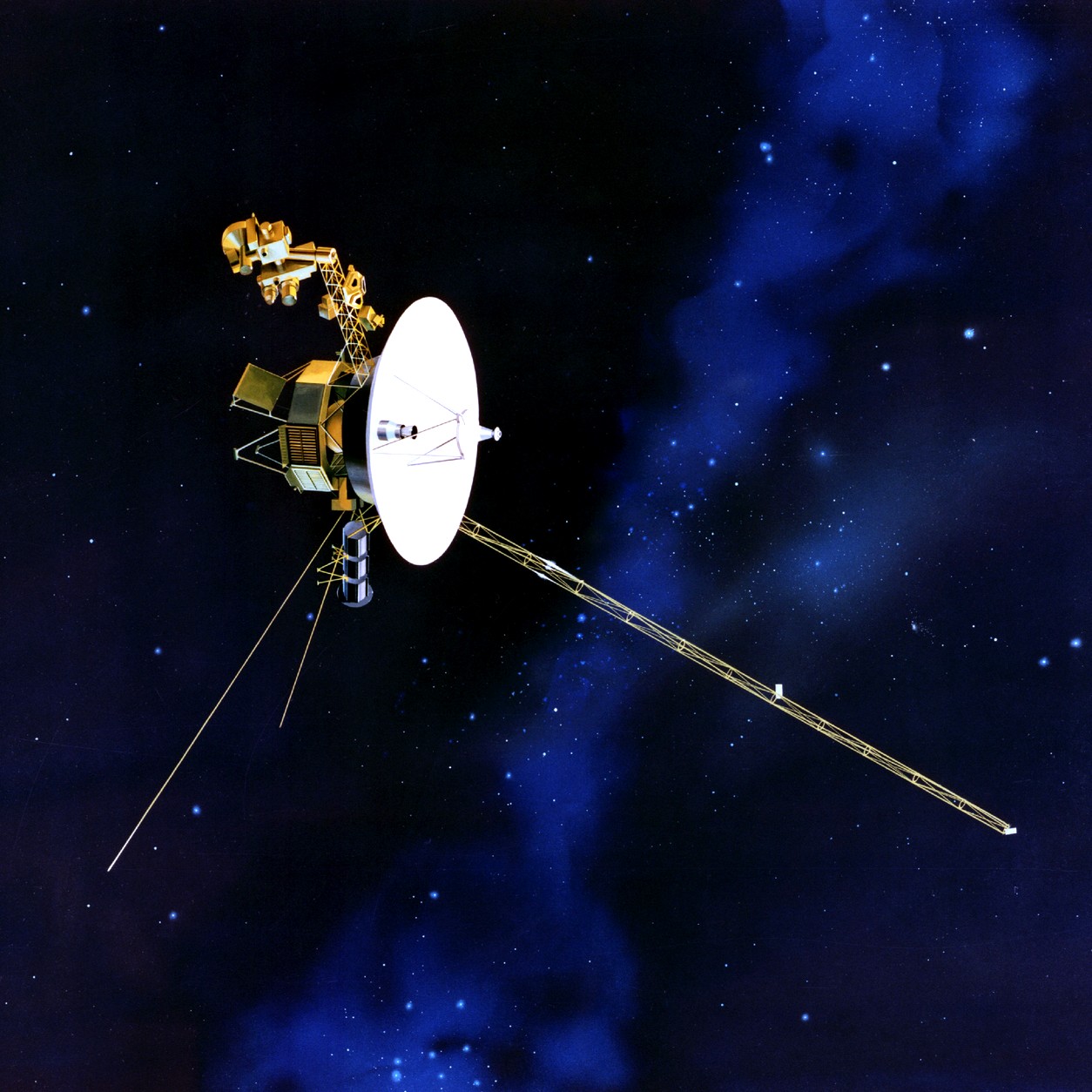
At 5:16 on Wednesday morning, Eastern time, a spacecraft launched when Jimmy Carter was president crossed an invisible line in the dark, 16.1 billion miles from home. No one saw it happen. The radio signal proving it would not reach Earth for another full day.
That delay was the whole point. Voyager 1 had just become the first human-made object ever to travel one light-day from Earth — the distance a beam of light covers in 24 hours.
People around the world had been counting down. They flashed flashlights and phone lights at the night sky. They turned the Empire State Building gold. But the engineers who fly the probe walked into their celebration carrying news they had made public only the night before: for days, Voyager 1 had stopped telling them anything at all.
A Message That Takes a Day to Arrive
Voyager 1 left Cape Canaveral on September 5, 1977, two weeks after its twin, Voyager 2. It was built for a mission expected to last five years. It took 49 years, two months and 11 days to reach this mark, cruising at about 38,000 miles per hour.
The scale is hard to hold in your head. Sunlight passing Earth reaches the Moon in about 1.3 seconds and Neptune in about four hours. It needs another 20 hours to catch up with Voyager 1.
“We listen to Voyager 1 every day and send commands to the spacecraft weekly. It just takes a little longer to communicate than it used to,” said Suzanne Dodd, the Voyager project manager at NASA’s Jet Propulsion Laboratory in Pasadena, California. Every command now spends 24 hours flying out, and every answer spends 24 hours flying back.
When the confirming signal finally landed early Thursday, most of the team had been up all night waiting for it.
The Tone With Nothing Inside
Here is what made the moment bittersweet.
On Saturday, November 14, a giant Deep Space Network dish in Canberra, Australia, locked on to Voyager 1 and picked up its carrier signal — the radio tone that normally carries the probe’s science and engineering data home. The tone was there. The data was not.
“We have an anomaly that is not something unseen before,” Dodd told Space.com. “We do have a very strong carrier signal. We currently don’t have a frame sync, so we’re not getting the science or engineering data currently.”
That tone still says a lot. It means the probe is alive, that its attitude computer is keeping it pointed at Earth, and that its antenna and transmitter work. NASA believes the trouble sits in the onboard computer that collects readings from the spacecraft’s systems and packages them for the trip home. The milestone itself was never in doubt: the probe cannot change its speed, so engineers confirmed the crossing using the bare carrier signal and decades of trajectory measurements.
Fixing it is another story. “It takes two days to diagnose anything on the spacecraft,” Dodd said. “So we can’t do anything fast, and the data rates are very low.” NASA says finding the cause “may take weeks or longer.”
“All of Us Old People Have Our Aches and Pains”
Voyager 1 has frightened its team before. In 2023 it sent a carrier signal with no data because of a fault in one of its onboard computers, and the lessons from solving that one are guiding the team now. This October, the probe went completely silent for about 48 hours — and then started talking again on its own. Engineers are checking whether the two episodes are linked.
Dodd sounds more like a patient family doctor than a worried mission chief. “These spacecraft are old,” she said. “All of us old people have our aches and pains, and you know, sometimes it takes longer to stretch out your muscles and remember things.”
“It’s pointed at the Earth. It’s sending us a strong carrier signal, and I’m confident that it won’t be too long, and it will send us data back.”
Tears, Gold Lights and a Backflip in Orbit
So the party went ahead. On Thursday the team packed JPL’s Von Karman auditorium for the first Voyager press event of its kind since 1989, when Voyager 2 flew past Neptune. People cheered, and some wiped away tears.
“I remember in 1977 I was standing at the Cape watching Voyager launch, and I never thought I would be here today, 49 years later, to celebrate Voyager’s one light-day,” said project scientist Linda Spilker. “What an incredible milestone.”
Two nights earlier, NASA had asked the whole planet to “Shine Bright for Voyager’s Light-Day” by flashing the probe’s call sign, V-G-R, at the sky in Morse code. In Manhattan, NASA science chief Nicky Fox and Ann Druyan — the widow of Carl Sagan, who helped create the probe’s famous Golden Record — flicked the switch that bathed the Empire State Building in gold.
Watching footage of children shouting “We love you, Voyager” nearly undid Fox. “I actually thought I was going to start sobbing,” she told Space.com.
Even orbit joined in. From the International Space Station, astronaut Jessica Watkins recorded a message for the probe: “Voyager 1, you have been a beacon of light, a symbol of exploration, a seeker of truth, a carrier of hope.” Then she signed off with a weightless backflip.
The Journey That Never Ends
Voyager 1 is now drifting toward a dim star called Gliese 445, more than 17 light-years away. It will pass within about 1.7 light-years of it — in 40,000 years. Its plutonium power source loses about 4 watts a year, and NASA expects its remaining instruments to keep working until at least the 50th launch anniversary next summer.
One day it will stop answering for good. When that happens, Dodd says, Voyager 1 “will become humanity’s silent ambassador to the stars.”
Fox prefers a different ending, because she doesn’t think there is one. “People sometimes think, ‘When’s the mission going to end?’ It’s never going to end,” she said. “Even when we can no longer talk to Voyager, they’re both going to keep going.”
Aboard, the probe still carries the Golden Record, packed with the sounds and pictures of home. One of its messages is spelled out in Morse code — the same code people all over the world flashed at the sky this week. It reads “Ad astra per aspera.” Through struggle, to the stars.
Marta Visser
Consumer editor
Marta has covered retail pricing and consumer rights for nine years and runs our basket-tracking tests.
One email a week. Every deal, checked.
No spam, no filler. Just the prices, recalls and stories that affect your week.