210,000 Carbon Monoxide Alarms Were Just Recalled — and the Next Day, Half a Million Homes Lost Power
One of them stayed silent during a real leak. Now the government and the company are giving owners two different instructions about what to do tonight.
26 November 2026 · 7 min read
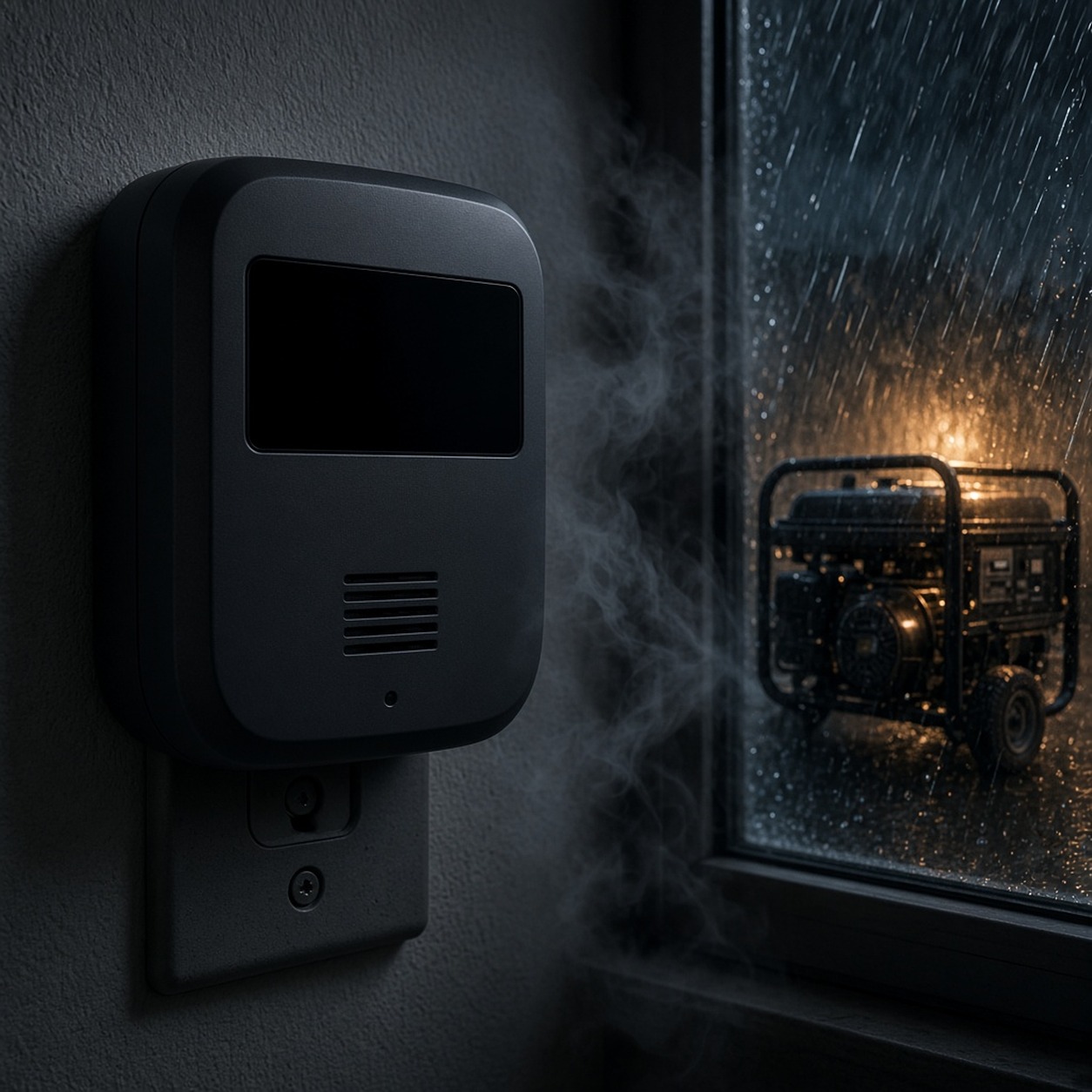
It plugs straight into the wall, it has a little black screen on the front, and it has exactly one job. Somewhere in the United States this year, one of them sat in its outlet while carbon monoxide leaked into the home around it — and it never made a sound.
That single report is now the reason roughly 210,410 of them are being pulled from American homes.
On Wednesday, Nov. 25, the U.S. Consumer Product Safety Commission announced a recall of the Steadfast Haven 4-in-1 plug-in carbon monoxide and natural gas detectors, sold by Zenara Commerce LLC of Sheridan, Wyoming. The agency’s wording was blunt: the detectors “can fail to alert consumers to the presence of hazardous levels of CO posing a risk of serious injury or death.” “Some recalls are more serious than others, and this is a serious one,” Reader’s Digest wrote the same day.
The timing could hardly be worse. Less than a day later, a Thanksgiving nor’easter was tearing down power lines from the mid-Atlantic to New England — the exact moment families drag out portable generators and trust that little box on the wall to scream if something goes wrong. And there is a twist hidden in the fine print: the government and the company don’t quite agree on what you should do with yours tonight.
The Alarm That Stayed Silent
The recall covers two models, both sold only online at truststeadfast.com between February and September 2026, for between $48 and $70.
The KH158 is the rounded one: a matte gray or white plastic housing with a glossy black digital display on the front, and the Steadfast logo printed on the gray versions. The GC03 is rectangular and black, again with a glossy black display. On both, the model number is printed on a white label on the back, on the side that plugs into the wall.
According to the CPSC, the company has received one report of a detector failing to alarm in the presence of a carbon monoxide leak. No injuries have been reported. On its own recall page, Steadfast says that report involved a KH158 — and that it is recalling the GC03 as well “out of an abundance of caution,” even though it has had no reports about that model.
One failure out of more than 200,000 units may sound like a rounding error. With carbon monoxide, it is not. The gas has no color, no smell and no taste. The Centers for Disease Control and Prevention says that each year more than 400 Americans die from unintentional carbon monoxide poisoning not linked to fires, more than 100,000 end up in an emergency department and more than 14,000 are hospitalized. Its early symptoms — headache, dizziness, weakness, nausea, confusion — are routinely mistaken for the flu. And the CDC warns that people who are asleep can die before they ever feel a symptom at all.
That is why a detector that misses a real leak is not an inconvenience. For a sleeping family, it can be the only warning they were ever going to get.
Half a Million Homes Went Dark the Next Day
By 2 p.m. Eastern on Thanksgiving, about 550,000 utility customers in the East had lost power, AccuWeather reported, as wind gusts of 50 to 70 mph hammered the coast. New Jersey declared a state of emergency, as did New York City, Long Island and Westchester County. Philadelphia’s Thanksgiving parade was canceled, and the 100th Macy’s parade in Manhattan was pushed to Saturday morning.
In the Philadelphia region alone, PECO reported 49,783 customers in the dark by mid-afternoon, with Chester County hit hardest, FOX 29 reported, while Delmarva Power counted roughly 22,000 more across Delaware and Maryland.
“Should there be extensive tree damage in some neighborhoods, the power could be out for days,” AccuWeather’s vice president of forecast operations, Dan DePodwin, warned.
Days without power is precisely when carbon monoxide turns deadly. The CPSC says portable generators alone kill an average of nearly 100 people in the U.S. every year, and that the poisoning “can kill in minutes” — fast enough that victims can pass out before they recognize the nausea or dizziness. The agency calls carbon monoxide the “invisible killer.” Opening a door or a window, it stresses, does not provide enough ventilation to stop it building up.
The Instruction That Doesn’t Match
Here is where the recall gets strange.
The CPSC notice tells owners to contact Zenara “immediately for a free replacement” and to “continue to use the recalled detectors until they install the replacement.”
The company’s own recall page reads differently. Under the question “My detector seems fine, can I still use it?” Steadfast answers: “No. Please stop using this product immediately and register for your free replacement.”
So which is it? The safest reading of both is that the recalled unit should not be the only thing standing between your family and carbon monoxide. The CPSC’s standing advice is to have working CO alarms on every level of the home and outside sleeping areas, with battery power or a battery backup, and to test them monthly. In a separate warning this fall, the agency also urged consumers to buy only alarms that meet the UL 2034 safety standard for CO alarms and UL 217 for smoke alarms.
There is one more catch. Steadfast says it is not offering refunds — only a replacement approved by the CPSC — and that the remedy is available only to people who still have the recalled detector, have marked it as required, and agree to dispose of it once their registration is verified.
It’s Not the Only Alarm Under Scrutiny
The Steadfast recall lands less than a month after a separate CPSC warning about a different set of cheap alarms sold on Amazon and eBay.
On Oct. 29, the agency urged consumers to immediately stop using combination smoke and carbon monoxide alarms with the model number JZA-540COM, sold under the JuzhiAnn, Yfwsrecinoe and JAEHSKA brand names from November 2023 through October 2026, for between $11 and $107. About 51,825 were sold. The CPSC said it was aware of seven reports of the alarms failing to sound in the presence of smoke or fire — and that the seller, Shenzhen Laijinhe Trading Co., Ltd., “has been unresponsive to CPSC’s request to recall these products.” The agency’s advice: throw them away, install working alarms, and don’t sell or give them away.
How to Check the Alarm on Your Wall Tonight
If you bought a plug-in carbon monoxide or gas detector online this year, take 60 seconds to check it:
- Unplug it and look at the white label on the back. Recalled models are Steadfast Haven KH158 (rounded, gray or white) and GC03 (rectangular, black), sold at truststeadfast.com from February to September 2026 for $48–$70.
- If it matches, register for a free replacement at truststeadfast.com/pages/recall, or email recall@truststeadfast.com.
- With a permanent marker, write “RECALLED” and your initials on the detector, photograph it and send the photo as directed, including your full name. Wait until your registration is confirmed before throwing it away.
- Replacement choices are the Kidde COPD carbon monoxide detector with digital display, available now, or the Kidde COPDLG carbon monoxide and natural gas detector, expected from the end of December 2026.
- Don’t rely on a recalled unit alone. The CPSC recommends battery-powered or battery-backup CO alarms on every level of the home and outside sleeping areas, tested monthly.
- If you own a JZA-540COM smoke and CO alarm (JuzhiAnn, Yfwsrecinoe or JAEHSKA), the CPSC says to stop using it now and replace it.
- If the power is out: run a portable generator outside only, at least 20 feet from the house, with the exhaust pointed away — never in a garage, basement, shed, porch or carport.
- If anyone in the home gets a headache, dizziness, nausea or confusion, get everyone outside immediately and call 911 from a safe place.
The Box on the Wall
Most people plug in a carbon monoxide detector once and never think about it again. That is the whole point: it is supposed to sit quietly for years and only speak up on the worst night of your life.
This week, across 210,000 homes, that quiet means something different. The storm will pass, and the lights will come back on. The only way to know whether that little box would have screamed is to stop trusting it — and check the label tonight.
Do you have a carbon monoxide detector in your home, and when did you last test it?
Marta Visser
Consumer editor
Marta has covered retail pricing and consumer rights for nine years and runs our basket-tracking tests.
One email a week. Every deal, checked.
No spam, no filler. Just the prices, recalls and stories that affect your week.